


Bible Study Series: Peter the Apostle
John 13:1-10 Typology and lessons in the washing of Peter's feet
by Fraser Gordon
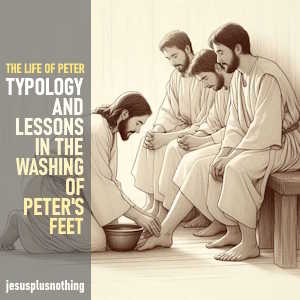 Hello saints, we are continuing with our studies into the life of Peter. This time we're looking at John 13. It's the feast of Passover and Jesus is with the twelve disciples having a meal among friends that includes a foot washing. We have the same event two chapters in a row. A meal with friends and a foot washing. In Chapter 12 Jesus was having a meal at a home and Mary washes our Lord's feet but in Chapter 13 the Lord Jesus Christ does the foot washing Himself.
John 13:1 Now before the feast of the Passover, when Jesus knew that His hour had come that He should depart from this world to the Father, having loved His own who were in the world, He loved them to the end. 2 And supper being ended, the devil having already put it into the heart of Judas Iscariot, Simon's son, to betray Him, 3 Jesus, knowing that the Father had given all things into His hands, and that He had come from God and was going to God, 4 rose from supper and laid aside His garments, took a towel and girded Himself. 5 After that, He poured water into a basin and began to wash the disciples' feet, and to wipe them with the towel with which He was girded. 6 Then He came to Simon Peter. And Peter said to Him, "Lord, are You washing my feet?" 7 Jesus answered and said to him, "What I am doing you do not understand now, but you will know after this." 8 Peter said to Him, "You shall never wash my feet!" Jesus answered him, "If I do not wash you, you have no part with Me." 9 Simon Peter said to Him, "Lord, not my feet only, but also my hands and my head!" 10 Jesus said to him, "He who is bathed needs only to wash his feet, but is completely clean; and you are clean, but not all of you."
The Passover meal is when the Israelites celebrate their deliverance from Egypt. When they killed the Passover lamb and applied the blood over the doorposts. It pictures being delivered out of the land of Egypt into all God's promises.
The way up is down
One of the contexts to this passage is in Luke 22.24. There was a dispute among the 12 disciples of who should be considered the greatest. Oh the flesh! The disciples were arguing among themselves and unbeknown to them they are just about to have their last fellowship with the Lord Jesus Christ. They are arguing about who's going to be the best, the most recognised, the most praised, and who will be the greatest! Unfortunately saints, the flesh is like that. It wants to be recognised, praised, and exalted. They were grasping for positions and recognition. Into this scene the Lord Jesus Christ lowers Himself. He demonstrates to His disciples that if they want to be the greatest, they must first become the least of all. The way up is down. Jesus reverses everything. They want to exalt themselves to be the best yet Christ gives them an example of what true leadership is, one of lowering yourself.
John 13:4 rose from supper and laid aside His garments, took a towel and girded Himself. 5 After that, He poured water into a basin and began to wash the disciples' feet, and to wipe them with the towel with which He was girded.
In the culture of the day, foot washing was common. What was not common was someone of Jesus' reputation doing it. It was a task normally done by a servant, a slave or even a gentile. It's different for us in the West because foot washing is not a common occurrence but in Jesus' day it was. It‘s a little bit like sweeping the floor, something we all do and a common occurrence. But if the Queen of England came to your house and swept the floor it would be really confronting. Not because of the sweeping but because of the one who is doing it. Here Jesus takes the form of a slave or servant and performs the task.
The sin offering
There is typology in this. He “rose from supper and laid aside His garments, took a towel and girded Himself”. This is the typology of Philippians 2.6-7 “who, being in the form of God, did not consider it robbery to be equal with God, but made Himself of no reputation, taking the form of a bondservant, and coming in the likeness of men”. Jesus laid aside His garments in heaven and His deity and came to earth, He lowered Himself and took on humanity. The towel is important and would have become quite dirty because the disciples had been walking on dusty roads. It pictures for us saints that Jesus is the one that cleanses from all dirt, all filth and all sin. Afterwards the towel is discarded because in verse 12 we see that Jesus puts His garments back on and doesn't put the towel on. This is a type of the Lord Jesus Christ leaving His deity and all the glory He had in heaven and taking on humanity. He came to wash mankind of all the sin, filth and dirt. Then that is put away and He returns to glory and puts His garments back on.
2 Corinthians 5.21, “For He made Him who knew no sin to be sin for us, that we might become the righteousness of God in Him”.
Even though He was perfect, holy and just, He was made the sin offering. He took sin upon Himself and was judged for you and me. In Titus 3.4-5 it says the same type of thing. “But when the kindness and the love of God our Savior toward man appeared, not by works of righteousness which we have done, but according to His mercy He saved us, through the washing of regeneration and renewing of the Holy Spirit”. Jesus washing the disciples feet is a picture of salvation. Jesus lowered Himself and took the form of a servant to wash their feet.
Free to bless wholeheartedly
Not only did He serve all 12 of the disciples in this way, but one of them was not clean. Jesus goes on to say in John 13.10 “You are clean, but not all of you”. Which obviously meant Judas. Even in John 13.2 it says, “And supper being ended, the devil having already put it into the heart of Judas Iscariot, Simon’s son, to betray him”. It amazes me that Jesus served Judas in this lowly way. He washed Judas' feet knowing he was about to betray Him. If that was me, and this was my last supper with friends, I would have exposed Judas and said there's one that should not be among us, one that's about to stab me in the back and betray me! We've got to get him out!”. But Jesus didn't do that, instead He lowered Himself and washed Judas’ feet knowing he was about to betray Him.
How would you act knowing that someone was about to betray you and stab you in the back? Jesus shows us that we can bless those who are going to betray us. Jesus was free to bless. In John 13.3 it says, “Jesus knowing that the Father had given all things into His hands and that He had come from God and was going to God”. I believe that was part of the freedom Christ had. He knew His position in God and knew He was secure. He knew the Father loved Him and knew the Father was going to make Him a sin offering. Even so, He was free enough to lower Himself and bless Judas.
It can be exactly the same for us. If we know our position in God, if everything is put under His feet, then we are free to bless those even though they mistreat, curse, betray, or malign us. We are free to act in such a way that we can wholeheartedly bless them. I heard a story, not that long ago about a pastor of a church in America. There was a big piece of land the pastor was going to buy which would provide everything the church needed at that time. The pastor then told another pastor about this land and how it would be a great blessing to their church. He even told him the amount he was going to purchase the land for. Now this other pastor went behind his back to the owner and bought it for himself, right from under this other pastor. Do you think there would be resentment?
I also heard the story of how this pastor responded. He went to the pastor that betrayed him and gave him and the church a love gift offering which they could use to make improvements to whatever they built on the land. The pastor said that he was free to bless this man and had done it wholeheartedly. It freed him from all resentment, anger and wanting to get even, even though he had been betrayed. He was in such a position in God that he put all things under the father's feet. In John 13 Jesus shows us that it is possible to bless those who betray us.
I wonder as Jesus washed the disciples feet and came to Judas, what was going through the heart of Judas? Jesus humbly as a servant washed the dirt from his feet, lowering Himself and yet Judas is about to hand Him over for 30 pieces of silver.
You shall never wash my feet!
John 13:6 Then He came to Simon Peter. And Peter said to Him, "Lord, are You washing my feet?"
Now we get to Peter. Jesus is going around the disciples but it doesn't say where Peter is in the line up. Peter's obviously been watching his King and Lord washing the other disciples' feet and is offended at the thought of his rabbi, teacher, and Messiah lowering Himself so much. Peter takes offense but Jesus replies to him saying, “What I am doing you do not understand now, but you will know after this”. Once again the disciples have no understanding of the suffering Messiah or of one who would lower Himself. From Peter's perspective Jesus was too great a man to be in a position of washing feet. Jesus says, you don't understand now but you will understand one day. We see this constantly with the disciples. They didn't have a clue about God's will for the Messiah; that He would be a suffering servant, would die for the sins of the world and then rise from the dead. That’s what Jesus meant when He said one day they would understand why He was washing their feet and the spiritual significance of it.
John 13:8 Peter said to Him, "You shall never wash my feet!" Jesus answered him, "If I do not wash you, you have no part with Me."
What a strong statement from Peter! Peter is so sure about himself and about so many things. He did not want Jesus to ever wash his feet. It’s just not going to happen. He's so sure in his own mind that he's correct about the Lord Jesus Christ. Peter felt unworthy of Jesus serving him because Jesus was too great a rabbi to lower Himself in this way. This is what the disciples didn't understand. Remember the dispute at the beginning? They were all talking in Luke 22 about who would be the greatest. Then Jesus flips it all on its head and performs the lowest of tasks, washing their feet. Peter took offence because that's not the way things are supposed to be. The person in charge doesn't stoop to the lowest position. Jesus replies to Peter, “If I do not wash you, you have no part with Me”. What is Jesus talking about? Is He talking about salvation? Jesus goes on to explain what He means.
John 13:10 Jesus said to him, "He who is bathed needs only to wash his feet, but is completely clean; and you are clean, but not all of you."
Jesus uses a physical reality to portray a spiritual truth. Jesus is not talking about salvation because “He who is bathed needs only to wash his feet”. In the culture of Peter’s day they got up in the morning and washed. They would then go about their day and as they walked they would get dirty feet. There are two Greek words that Jesus used in this passage. The Greek word for bathed is louó which means to fully soak or bathe the whole person. It's a complete washing and pictures salvation. When we get saved we are fully immersed into the Lord Jesus Christ and fully soaked into His presence. There is a complete washing. The second word is niptó which means to wash your hands or feet. Peter had already been bathed clean, louó so only needed washing, niptó which is a partial cleansing. In this world we pick up dirt and muck and get defiled by the wisdom of the world. What we listen to and the things we see have an effect on us. We need continual cleansing - niptó.
The bronze laver
In the tabernacle of meeting the priests' approach toward God in the Holy of Holies included two articles. The first was the bronze altar where the blood sacrifice was offered. The second article was the bronze laver. In Exodus 30.17-21 God commanded Moses to make a laver of bronze. It had a foot area and a bowl filled with water where the priests would wash their hands and feet. We know from Exodus 38 that the bronze laver was made from the donations of the mirrors of the serving women. The women gave up something precious to them, brass mirrors which they could see themselves in and prepare themselves with.
Bronze always speaks of judgment. We see this in the bronze altar, the bronze laver, and the bronze serpent lifted up on a pole in the wilderness. Silver always speaks of redemption, and gold always speaks of deity. As the priests approached the bronze laver they would see themselves in the reflection. Both the bronze and the water in the laver showed them what they looked like. It's a picture of the word of God which reveals our dirty condition. If there was one word for the priest in approaching God it was wash, wash, wash. They had to wash their feet and hands in the laver which revealed to them their need for cleansing.
We see the same imagery in Psalm 119.9 which says, “How can a young man cleanse his way? By taking heed according to Your word”. Ephesians 5.26 tells us that Christ gave Himself for the church “that He might sanctify and cleanse her with the washing of water by the word”. Also in 1 John 1.9 “If we confess our sins, He is faithful and just to forgive us our sins and to cleanse us from all unrighteousness”. In this world we will get dirty and we need cleansing too just as the priests did in their approach toward God. These scriptures talk about the importance of the word of God and coming to the Lord Jesus Christ to seek that cleansing. He is faithful and just to cleanse us from all unrighteousness.
A man of extremes
Peter responds by saying in John 13.9 “Lord, not my feet only, but also my hands and my head!" This reminded me of Psalm 51 which was written by David who needed washing and cleansing after his great sin with Bathsheba and Uriah. In verse 4 he writes, “Against You, You only, have I sinned, and done this evil in Your sight”. I am always amazed that David recognised his sin was first and foremost against God. Yes, he had sinned against Bathsheba by taking her, and yes, he had sinned against her husband Uriah. But David recognised that sin is first and foremost breaking God's law and failing God's righteous standard. Sin is first an offence toward God as David stated, “against You, You only, have I sinned.
In verse 7 of Psalm 51 he continues, “Purge me with hyssop, and I shall be clean”. Hyssop was the little shrub used to apply the blood of the lamb over the doorposts in Exodus when Israel came out of Egypt. It speaks of salvation. David then says, “Wash me, and I shall be whiter than snow”. David knew he needed to be fully cleansed. He had sinned and broken God's laws and wanted to be restored back into fellowship with the Lord. Peter's response in John 13.9 is similar. He realised that to have any part with the Lord Jesus Christ he needed to be fully washed. Jesus said to him “If I do not wash you You have no part with me”. Peter says to him Lord, not my feet only but also my hands and my head. He's like David, he wants everything to be washed, he's all in.
Peter is a man of extremes and this is one of the reasons why I love him. One minute he says, “Depart from me, for I am a sinful man”, then he forsakes all to follow Him. Then the Lord blesses him, “For flesh and blood has not revealed this to you”. Then next minute, “Get behind me Satan!” From one extreme to the other, “You shall never wash my feet” to wash everything! One minute he attempts to fight on behalf of the Lord Jesus Christ in the garden of Gethsemane by cutting off the ear of a soldier and yet then ends up denying that he even knew Him! Of all the disciples Peter is the one that seems to end up in trouble and I think this is just part of his character. He is always getting himself into situations where he needs to be rescued and the gospels highlight this in his life. Whatever he thinks comes out of his mouth. He thinks he is right most of the time only to find out that he's got the wrong end of the stick.
Lessons learned
What did Peter learn in this passage?
- Firstly, Jesus was trying to teach His disciples about service. They were having a dispute about who would be the greatest and Jesus showed them that the greatest will lower himself. He will not only take the place of a servant but he will serve as a servant does. True leadership is willing to lower themselves to the lowest job. Jesus washes the disciples feet and shows them that a great leader will lower himself and do tasks which are sometimes offensive.
- Secondly when Peter and the other disciples looked back on this event they would realise that there were 12 men in the room. They would have realised that Jesus knowingly blessed Judas even though he didn't deserve it. Jesus washed Judas’ feet and showed us how to act toward those who are going to wrong us or betray us. He does it with pure love in His heart.
- Thirdly Peter and the disciples would have learned the spiritual truth of, “If I do not wash you, you have no part with me”. You and I saints need continual washing - niptó. We walk in this dirty world which is contrary to everything that God stands for. We get dirty and filthy and need continual washing to be in close fellowship with the Lord Jesus Christ. We need to apply the Word of God to our lives daily. It reveals that we are dirty but also cleanses and puts us in close fellowship with the One we love and serve. We need to be continually washed just as 1 John 1.19 says “If we confess our sins He is faithful and just to forgive us our sins and to cleanse us from all unrighteousness”.
I pray that you and I would apply this to our lives and the Lord Jesus Christ would speak to us all. This is one event which happens to Peter before he denies the Lord Jesus Christ. The second event that I want to look at is the warning from the Lord Jesus to Peter in Luke 22:31-32 “And the Lord said, "Simon, Simon! Indeed, Satan has asked for you, that he may sift you as wheat. But I have prayed for you, that your faith should not fail; and when you have returned to Me, strengthen your brethren." We will look at that next time as we continue in our studies. God bless you and I pray that the word of God be rich and alive to you all Amen.